
Myths About Physiotherapy - Breaking the Silence, Celebrating the Science
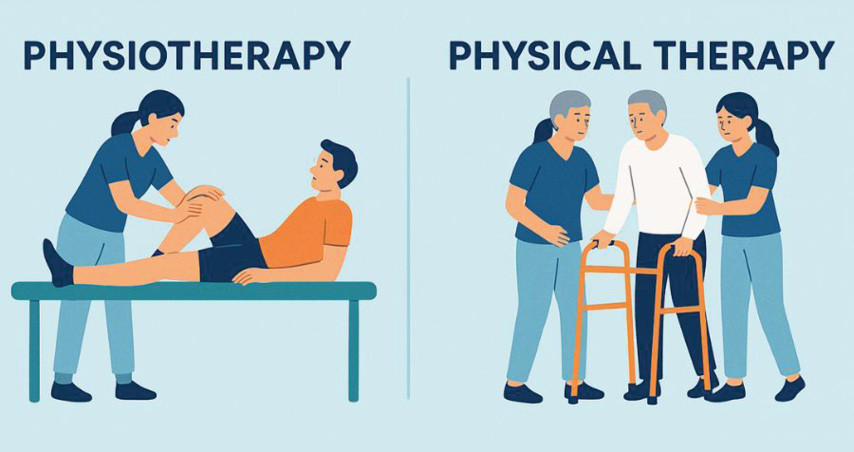
A physiotherapist treats a patient from womb to tomb.
- From premature infants in NICU
- to toddlers with developmental delays,
- from athletes with injuries
- to adults recovering from stroke,
- from post-surgical patients
- to elderly struggling with balance
Physiotherapy holds every life-stage with scientific care and human compassion.
For years, physiotherapy in India has lived under the shadow of misunderstanding.
- Not because physiotherapists lack knowledge.
- Not because physiotherapy is any less scientific.
- But because myths travel faster than truth.
- Today, it is time to break those myths—loudly, clearly, and unapologetically.
Myth 1: “Physiotherapists are not doctors.”
Truth: If diagnosing, assessing, planning treatment, and restoring health defines a doctor—then a physiotherapist is one, too.
A physiotherapist is the professional who:
- Assesses the patient from head to toe
- Diagnoses the impairment or dysfunction
- Plans the treatment
- Executes therapy scientifically
- Restores movement, function, independence, and quality of life
- If a professional who heals you, explains your pathology, monitors your progress, treats your pain, and brings you back to life is not a “doctor,” then who is?
- In every modern healthcare system across the world, physiotherapists are recognized as Doctors of Physical Therapy or Doctor of Physiotherapy.
- The knowledge, the training, the responsibility—they all justify the title.
- A doctor heals with medicines, a surgeon heals with scalpel, and a physiotherapist heals with hands, movement, science, and rehabilitation.
- Healing is healing—no matter the tool.
MYTH 2: “Physiotherapy is not necessary in hospitals.”
Truth: Without physiotherapy, hospitals may treat diseases—but cannot restore lives.
A patient does not come to a hospital only to survive.
They come to walk, move, work, and live normally again.
Who enables that? The physiotherapist.
- A stroke patient cannot lift a finger without physiotherapy.
- A spinal injury patient cannot sit up without physiotherapy.
- An orthopedic case of —ACL tear, fracture fixation, joint replacementcannot stand or walk without physiotherapy.
- A post-operative patient will remain bedridden without physiotherapy
Surgeons repair and Physiotherapy restore.
A hospital without physiotherapy is like a car without wheels—everything is present, but nothing can move forward.
When people say physiotherapy is “not necessary,” they forget one thing:
If rehabilitation stops, recovery stops.
MYTH 3: “Physiotherapy students don’t study medical subjects.”
Truth: Physiotherapy students study all core medical sciences—plus additional specializations.
A physiotherapy student studies:
- Anatomy
- Physiology
- Pathology
- Psychology
- Pharmacology (related to rehab)
- General medicine
- General surgery
- Neurology, orthopedics , cardiology, paediatric, gynecology
- Microbiology & biomechanics
And in addition:
- Electrotherapy
- Exercise therapy
- Bioengineering
- Biomechanics
- Mobilization techniques
- Evidence-based rehabilitation sciences
A doctor of physiotherapy studies the human body inside-out because the job demands restoring movement, the most complex function of the human body.
To say physiotherapy students don’t study medical books is like saying a pilot doesn’t study aerodynamics.
Myth 4: “Physiotherapists are less important than other doctors.”
Truth: Healthcare is a team—every member is indispensable in a hospital:
- A dentist treats your oral health
- A gynecologist treats reproductive health
- A physician treats internal diseases
- A surgeon performs operations
- A physiotherapist restores function and independence
- You cannot ask a dentist to do a bypass surgery.
- You cannot ask a physician to perform a knee replacement.
- And you cannot ask anyone but a physiotherapist to rehabilitate the patient after that knee replacement.
- Every doctor has their own expertise.
- Every specialty is a pillar of healthcare.
- Physiotherapy is one of those pillars.
- It is not “less important”—it is differently important.
Why does India Still Struggle to Recognize This?
- Because physiotherapy is one of the fastest-growing medical sciences.
- Because physiotherapists in India are pushing boundaries.
- Because rehabilitation has the power to change lives—and some people are not ready to accept new truths.
But think once:
- If you respect dentists as doctors,
- Respect nutritionists, psychologists, homeopaths, and surgeons,
Why not physiotherapists—who give five years, and often seven years with post-graduation, mastering the science of movement?
- If literacy means “understanding,” then an educated society must understand this:
- No profession should be disrespected.
- No healing science should be belittled.
- And no healthcare provider should be dragged backward.
The Future of Physiotherapy in India
Physiotherapy is not the “backward” profession people assume—it is the future of healthcare.
Rehabilitation can:
- Reduce disability
- Restore independence
- Prevent lifelong complications
- Reduce hospital stay
- Improve quality of life
- Help amputees use prosthetics
- Help children with disabilities grow stronger
- Help elderly stay active
- Help athletes return to sport
- Help neurological patients regain lost abilities
Physiotherapy has the power to give life back—step by step, movement by movement.
Imagine an India where:
- Disabled individuals walk independently
- Post-surgical complications are reduced
- Stroke survivors regain function early
- Elderly patients stay active
- Athletes recover faster
- Chronic pain is prevented, not suffered
This India is possible—if we stop undermining physiotherapy and start embracing it.
A Final Message to the Nation
- A physiotherapist is not “less.”
- He is not “optional.”
- He is not “just a technician.”
- A physiotherapist is:
- A doctor of rehabilitation.
- A specialist of movement.
- A scientist of human function.
- And a healer of independence.
- Hospitals need physiotherapy.
- Patients need physiotherapy.
- India needs physiotherapy.
- It is time we stop the myths—
- And start the respect.